What is balance, and why does it decline as we age?
We don’t think much about balance until something happens that makes us question it. Maybe we stumble on an uneven sidewalk, feel unsteady stepping out of the shower, or find that standing on one foot to put on our pants isn’t as easy as it used to be.
Balance helps us stay upright, adjust to changes under our feet, and move confidently through the world. But it isn’t just one skill, and it isn’t controlled by one part of the body.
Balance is a team effort
Think of balance as a conversation between your brain and several systems in your body. They’re constantly sharing information and making tiny adjustments, usually without you noticing.
Our eyes (vision)
Our eyes tell us where we are in relation to the world. They help us judge distances, spot obstacles, and see changes in the ground. Walking through an unfamiliar room in the dark is harder because we lose this important source of information.
Our inner ear (vestibular system)
Deep inside our ears is a system that senses head movement and helps us stay oriented. That’s one reason an inner ear problem can make us feel dizzy or unsteady.
Our body's sense of position (proprioception)
This is our ability to know where our body parts are without looking. You can touch your knee with your eyes closed because your brain has a sense of where it is. Sensors in our muscles, tendons, and joints—and sensation from the soles of our feet—help us understand our position and movement.
Your brain combines all this information and tells your muscles how to respond, often in fractions of a second.
So why does balance decline as we get older?
The systems we depend on can gradually become less efficient with age. Vision changes. The inner ear can become less sensitive. Our sense of where our feet and joints are may diminish. We may also lose muscle strength and power, and our reactions may slow.
But there’s another factor worth talking about: we often stop practicing movements that challenge our balance. As children, we climb, jump, balance on logs, and explore uneven ground. As adults, our movements often become more predictable. We walk on smooth surfaces and avoid situations that make us feel unstable.
That caution is understandable, especially after a fall. But avoiding challenges entirely can create a cycle: we move less, our strength and balance decline, and we feel less confident about moving.
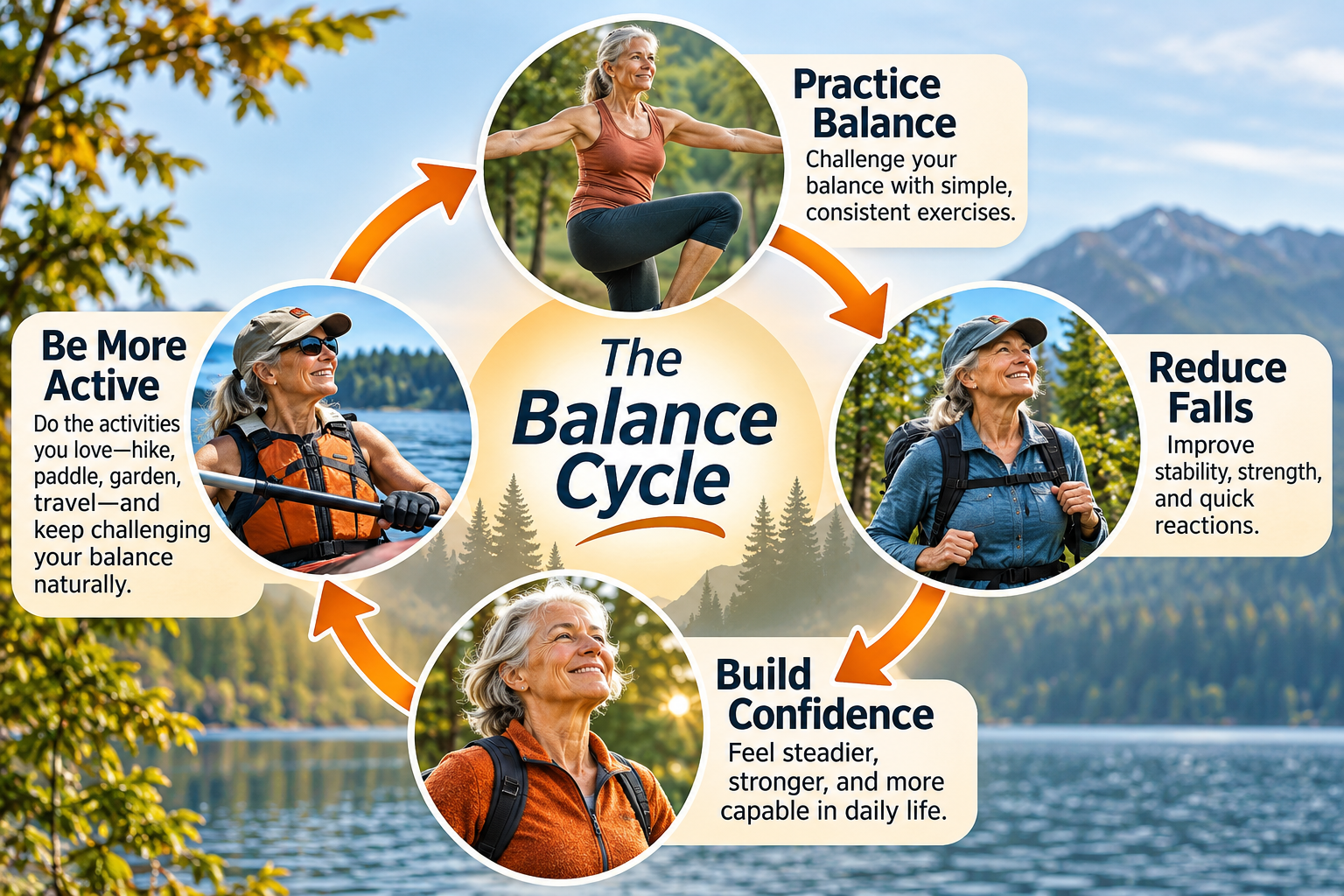
The good news? Balance can improve at any age.
While we can’t completely prevent natural changes with aging, we can train our bodies to make better use of the abilities we have. Strength training helps our muscles respond when we need to catch ourselves. Balance exercises challenge our brain to coordinate information from our eyes, inner ears, and body.
And balance training doesn’t have to mean standing on one foot for minutes at a time. It might mean stepping over obstacles, walking on different surfaces, changing direction, or shifting our weight safely. The key is to find challenges that suit our current abilities and gradually build from there.
Not every balance problem is simply aging. Medications, blood pressure changes, vision problems, nerve conditions, and inner ear disorders can affect balance. New or worsening unsteadiness deserves a conversation with a healthcare professional.
A final thought
I think of balance as more than the ability to avoid falling. It gives us confidence to explore, stay active, and remain independent—whether that means hiking, gardening, traveling, or getting down on the floor to play with a grandchild.
Balance isn’t something we either have or don’t have. It’s a skill we can keep developing throughout our lives.